
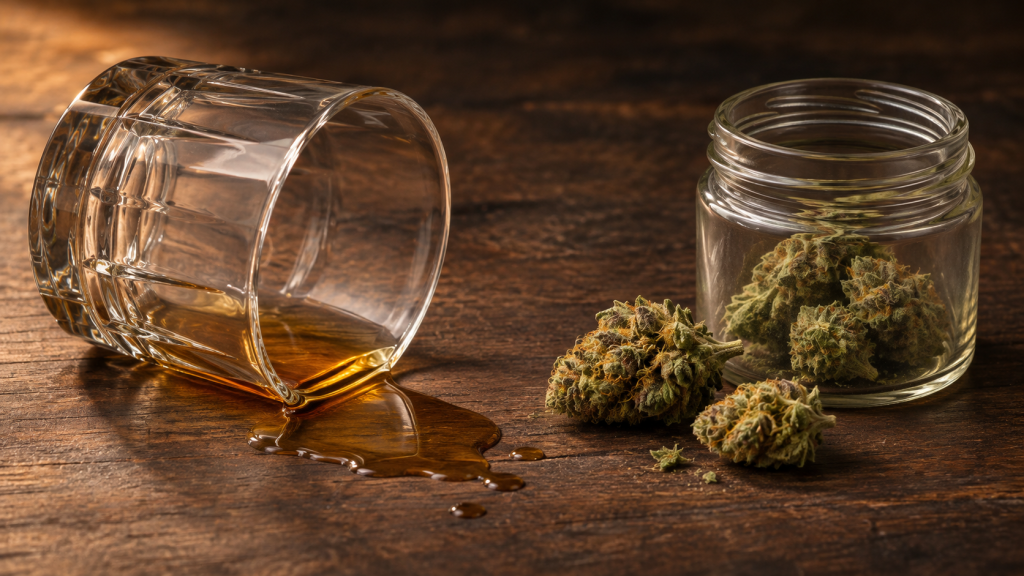
One thing we didn’t like about drinking was how it could make us feel more sure of ourselves at the very moment we had the least reason to be. After a few too many, it was easier to take things personally and harder to let them go. That’s what we call false courage. You feel bold enough to pick a fight over something you’d normally brush off.
Picture two strangers at a crowded bar, with a little too much to drink. One bumps into the other and spills his drink. The other takes it as disrespect. Suddenly he feels like he’s got something to prove to a person he doesn’t even know, all over a spilled drink.
That’s one of the main reasons we quit drinking. We didn’t like how easily a small thing could turn into a confrontation.
We came to cannabis for medical reasons. Every time we used it, we felt a little more chill. We noticed it in how we responded to people. A remark that might have set us off on a stressful day was easier to let pass. In a situation like the one at the bar, it was easier for us to think, “It was an accident,” and get on with our night.
Related video. Mind & Behavior looks at why some people use cannabis to unwind and questions the stereotype that using it makes people lazy. Watch the reel on Facebook (18+, Facebook login required).
Who are we asking to step back?
What sticks with us about that bar scene is how quickly one person’s need to prove a point can drag other people into a fight. We think about that when we watch leaders like Trump, Putin and Xi. Their decisions can pull whole countries into conflicts that ordinary people have to live through.
Here in Canada, we’ve felt the strain with the United States. Looking farther south, Trump imposed additional tariffs on Brazilian goods, authorized tariffs on countries that supply oil to Cuba, and ordered military action in Venezuela. Those are different actions, but they raise the same question for us. How much say do people have over their own future when a more powerful country decides to throw its weight around? Brazil tariff order · Cuba oil tariff order · UN briefing on Venezuela
We think about that when Ukrainians defend their country against Russia’s invasion and when Beijing pressures Taiwan. The people who have to live with those decisions deserve to make their own choices. When we ask for restraint, we’re asking it of the leaders applying the pressure.
We’ve wondered, seriously, what some of those leaders would make of cannabis if they tried it themselves. We know what it felt like for us to have less urge to turn a disagreement into a fight. We’d like to see more of that restraint from the people with the power to start one.
A country can stand its ground and still want peace. The most powerful leaders ought to respect that choice.